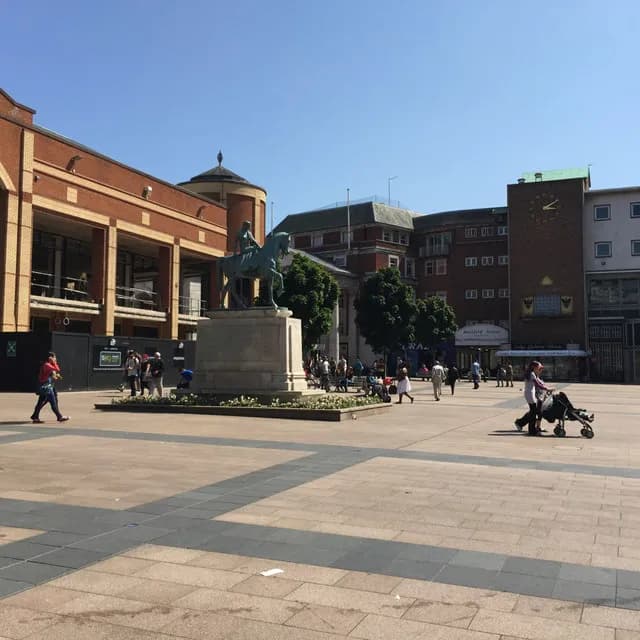
For nearly a millennium, the name Godiva has been inseparable from Coventry. The historical figure and the legend she inspired have shaped the city's identity, its public spaces, and its annual celebrations in ways that few other English cities can claim.
Who Was the Real Godiva?
Godgifu, Latinised as Godiva (meaning "gift of God"), was born around 995 AD and died sometime between the Norman Conquest of 1066 and the Domesday survey of 1086. She was the wife of Leofric, Earl of Mercia, and together they had nine children, including their son Ælfgar.
What sets Godiva apart in the historical record is her remarkable status as a landholder. She is one of only a handful of Anglo-Saxons, and the only woman, listed as a major landholder in the Domesday Book. Her signature, appearing on a charter as "Ego Godiva Comitissa diu istud desideravi" ("I, Countess Godiva, have desired this for a long time"), speaks to her influence, though historians debate the document's authenticity.
The Founding of Coventry's Monastery
Godiva's most concrete legacy in Coventry dates to 1043, when she and Leofric founded a Benedictine monastery in the city. The site had previously held a nunnery destroyed by Danish invaders in 1016. This foundation was no minor benefaction; it established Coventry as a significant religious centre and set the stage for the city's growth throughout the medieval period.
The couple's generosity extended beyond Coventry itself. Godiva made donations to St Mary's Worcester, Stow St Mary in Lincolnshire, and monasteries at Leominster, Chester, Much Wenlock, and Evesham. She directed in her will that a circlet of precious stones be placed on a statue of the Virgin Mary, representing the earliest known reference to rosary-like beads.
The Legend of the Naked Ride
The story most people associate with Lady Godiva first appears in the 13th-century Flores Historiarum by Roger of Wendover, written more than 150 years after her death. According to the legend, Godiva pleaded with Leofric to lower the oppressive taxes burdening Coventry's citizens. He agreed, but only on the condition that she ride naked through the streets. She accepted, issuing a proclamation that all residents should remain indoors. A tailor named Peeping Tom allegedly disobeyed, looking upon her and being struck blind or dead as punishment.
Modern historians regard the ride as myth. No contemporary chronicles mention such an event, and the story likely draws from pagan fertility rituals or penitential processions where participants wore only a shift. The "Peeping Tom" element appears even later; the first written reference to the tailor by name dates to Coventry annals from 11 June 1773.
From Folklore to Civic Emblem
Despite its questionable historicity, the legend propelled Godiva to the centre of Coventry's civic identity. The first recorded Godiva Procession took place in 1678, when "Lady Godiva rode before the Mayor to proclaim the Fair." This tradition became associated with the Trinity Great Fair, granted a charter by Henry III in 1217 or 1218.
By the 19th century, the procession had grown into a major civic event involving companies, bands, and benefit societies. The Victorian era saw a wooden effigy of Peeping Tom, likely dating from the reign of Charles II, displayed at Coventry fairs.
Monuments and Public Art
Coventry's streets contain multiple tributes to its famous benefactor. The most prominent is the bronze statue in Broadgate by Sir William Reid Dick, unveiled in 1949 following a £20,000 gift from W. H. Bassett-Green. The sculpture depicts Godiva on horseback, her figure rendered with the modesty appropriate to its era yet unmistakably conveying the legendary ride.
Another statue by William Calder Marshall, exhibited at the Royal Academy in 1854, resides at St Mary's Guildhall. The Godiva Clock, installed in Broadgate in 1953, animates the legend every hour: a figure of Lady Godiva rides around the clock's balcony while Peeping Tom emerges to peer out.
The Herbert Art Gallery and Museum houses a permanent Godiva exhibition, including John Collier's 1897 painting "Lady Godiva" and various historical artefacts connected to the legend.
Revival and Modern Celebration
The Godiva Procession declined during the 20th century but was revived in 1997, the same year the Godiva Festival began. What started as a single-day event in War Memorial Park became a three-day music festival by 1998, now attracting tens of thousands of visitors annually and ranking among the UK's largest free music festivals.
In 2000, Coventry City Council adopted a logo featuring Lady Godiva on horseback, cementing her place in the city's official visual identity. The city's halfpenny Conder token from 1792, Stevengraph woven silks depicting the procession from 1887, and even a 14th-century window at Holy Trinity Church (removed in 1775) all testify to her enduring presence in local material culture.
Living Legacy
No discussion of Godiva in modern Coventry would be complete without mentioning Pru Porretta, who has served as the city's unofficial Lady Godiva since the mid-1980s. Her contributions to Coventry's community life were recognised with an MBE in 2010.
Today, whether as the pious benefactor who founded a monastery or the legendary figure who rode for her people, Lady Godiva remains Coventry's most recognisable symbol. Her image greets visitors to the city centre, her name adorns its largest cultural festival, and her story continues to capture imaginations nearly one thousand years after she walked, or perhaps rode, through Coventry's streets.